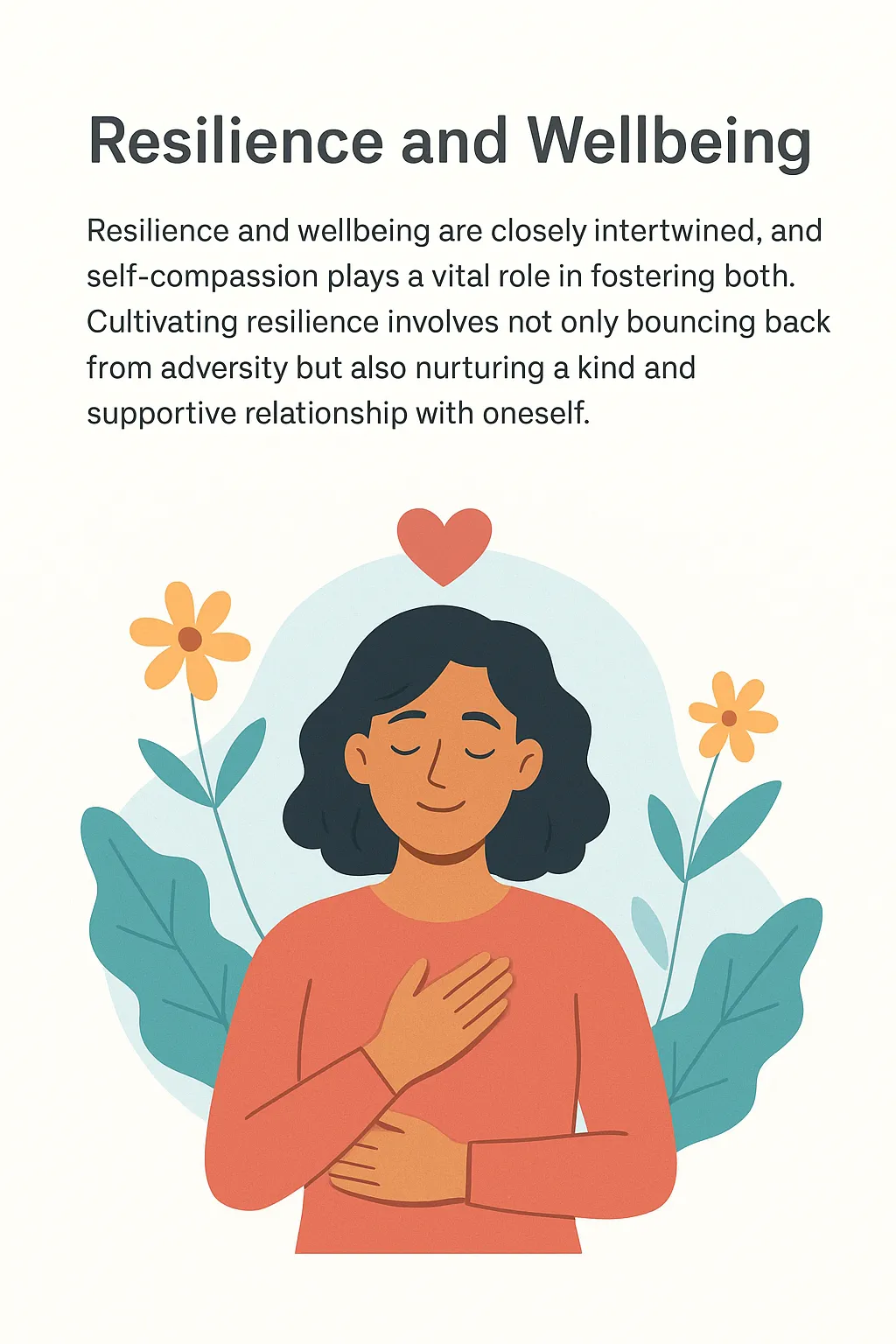
Resilience and Wellbeing: Boost Growth with Self-Compassion
Resilience and Wellbeing: The Power of Self-Compassion in Building Inner Strength

Resilience and wellbeing are often spoken about as essential qualities for navigating life’s challenges — and for good reason. In an increasingly fast-paced, uncertain world, our ability to bounce back from adversity, maintain balance, and sustain a sense of purpose and peace has never been more important. Yet, there’s a vital ingredient that is sometimes overlooked in this process: self-compassion.
At its core, resilience is not about avoiding stress or hardship but about adapting and recovering in the face of it. It’s the quiet strength that allows us to persevere through difficulties, learn from them, and emerge with greater wisdom and perspective. Wellbeing, on the other hand, encompasses a broader sense of flourishing — physical health, emotional balance, positive relationships, and a sense of meaning. The two are deeply interconnected: resilience supports wellbeing by helping us cope effectively with stress, and wellbeing fuels resilience by keeping our minds and bodies in a healthy, balanced state.
However, resilience is not built solely through toughness or endurance. While determination and perseverance are vital, true resilience is rooted in self-compassion — the ability to treat ourselves with the same kindness, understanding, and care that we would offer a close friend.
When faced with failure, rejection, or loss, many of us default to harsh self-criticism. We push ourselves harder, believing that self-judgment will motivate us to do better next time. But research in psychology, particularly the work of Dr. Kristin Neff, has shown that the opposite is true. Self-compassion doesn’t make us weak or complacent — it makes us stronger, more grounded, and more capable of growth.
Self-compassion involves three key elements: self-kindness, common humanity, and mindfulness.
Self-kindness means offering yourself warmth and care instead of criticism when you’re struggling.
Common humanity reminds you that suffering and imperfection are part of the shared human experience — you are not alone in your challenges.
Mindfulness allows you to acknowledge your feelings without being consumed by them, creating space for clarity and calm.
When we practice self-compassion, we shift from seeing ourselves as failures to recognizing ourselves as learners. Instead of “I can’t believe I messed that up,” we might think, “That didn’t go as planned, but I can learn and try again.” This subtle change in inner dialogue can transform the way we respond to setbacks. It softens the emotional impact of adversity and fosters resilience by allowing us to recover faster and more effectively.
Cultivating self-compassion also enhances overall wellbeing. It reduces stress, anxiety, and depression while increasing emotional stability, optimism, and life satisfaction. People who are kind to themselves tend to engage in healthier behaviors, maintain stronger relationships, and cope better with uncertainty.
Building resilience through self-compassion is not about ignoring pain or pretending everything is fine. It’s about acknowledging your struggles with gentleness and courage. It’s understanding that wellbeing doesn’t mean the absence of hardship but the ability to meet life’s challenges with grace and strength.
Ultimately, resilience and wellbeing are less about “bouncing back” and more about growing forward — learning to thrive, adapt, and care for yourself through every season of life. And that growth begins, quite simply, with a compassionate heart turned inward.
